FERALPI GROUP FOR DECARBONISATION
INDUSTRIAL PILOT FOR ELECTRICALLY-CONDUCTED BILLET HEATING POWERED BY RENEWABLE SOURCES LAUNCHED
FIRST APPLICATION IN EUROPE FOR CONSTRUCTION STEELS
The industrial pilot, developed within the framework of the European “Modiplant” project, accelerates innovation in the electrification of steelmaking processes.
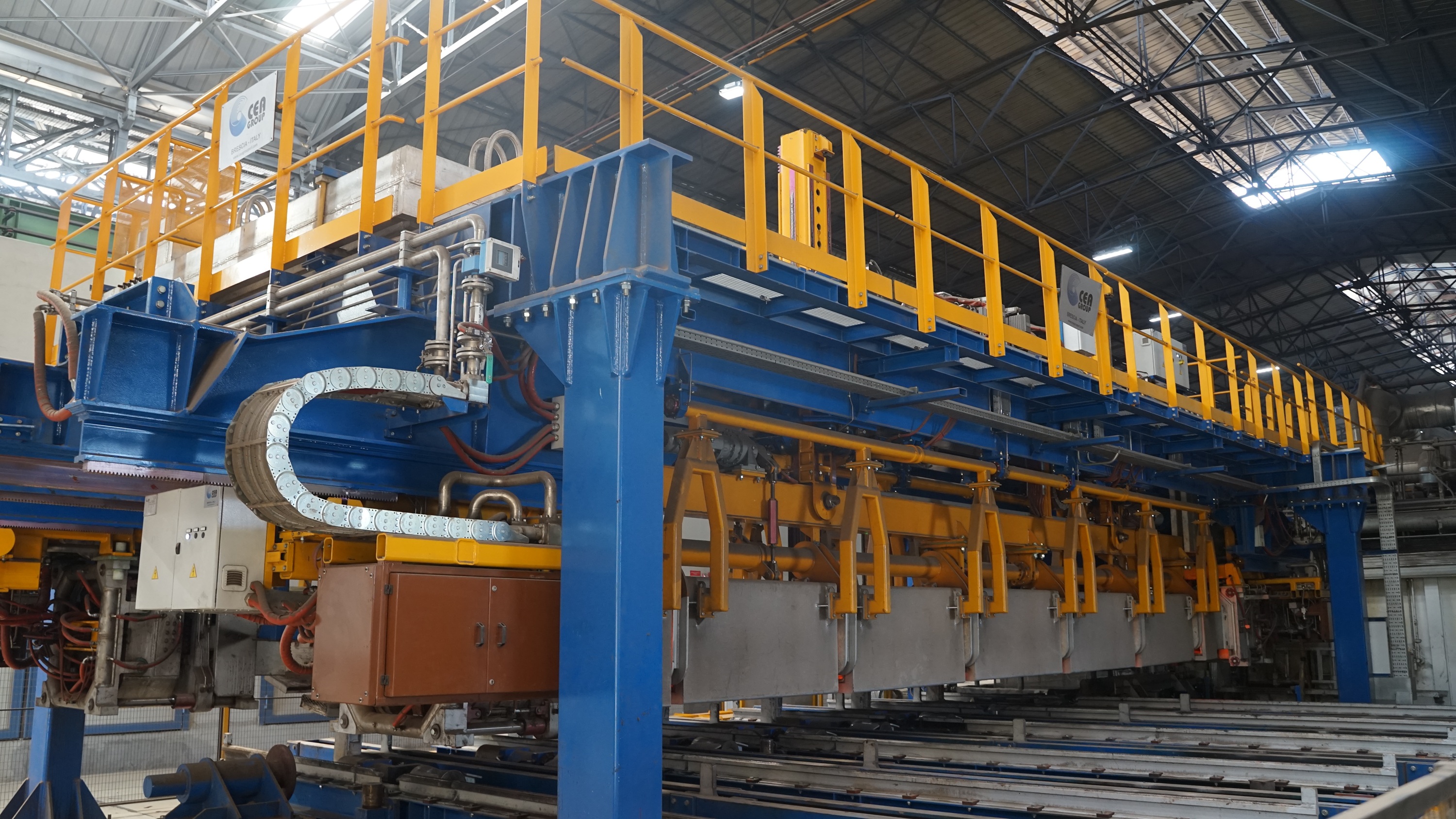
Feralpi Group takes another fundamental step forward in the ecological transition of the steel industry: the innovative industrial pilot for electrically-conducted heating of billets (semi-finished products destined for subsequent rolling) has been launched in Lonato del Garda.
The pilot features a Joule-effect technology that heats the billet rapidly and in a controlled manner before rolling, using energy from renewable sources to replace natural gas in the final section of the reheating process.
It represents a state-of-the-art demonstrator on an industrial scale and is the first in Europe ("First of a Kind" - FOAK) to apply this technology to the construction steel supply chain.
The demonstrator consolidates the Group’s climate strategy, which is aligned with science-based emission reduction targets (SBTi) and supported by continuous investments in renewable sources, energy efficiency, and the circular economy.
Specifically, this pilot plant enriches Feralpi’s broader electrification and energy efficiency strategy precisely through the use and field validation of experimental technologies, presenting itself as an additional innovative solution for electric arc furnace steelmaking.
THE PILOT PLANT TECHNOLOGY
The machine constitutes one of the operational hearts of the European research project Modiplant (MODular hybrId technology in the Steel PLANT production - Grant Agreement no. 101099118), funded by the European Union's Research Fund for Coal and Steel (RFCS) to identify concrete solutions for industrial decarbonisation.
The innovation leverages the direct electrification of processes, combining traditional natural gas-fired reheating furnaces with a Joule-effect technology that heats the billet quickly and in a controlled manner before rolling, using energy from renewable sources.
THE ADVANTAGES
The pilot plant targets several environmental and operational objectives.
First and foremost, direct decarbonisation and electrification (Scope 1) by replacing fossil-based gas with electricity from renewable sources in the final stage of reheating. For the portion of production treated by the pilot, this process occurs without direct combustion emissions.
Furthermore, the project aims for greater energy efficiency and metal yield thanks to immediate heat transfer and temperature homogeneity, with benefits in processing times and a reduction in scale production.
The full-scale industrial testing of this production paradigm is unprecedented in the construction steel sector (First of a Kind model). This field test therefore represents a systemic contribution to the supply chain, which can contribute to the development of the entire steel sector by offering the industry an additional technological lever to address environmental and market challenges.
Finally, the pilot plant serves as an enabling technology for future applications, as it allows for the acquisition of operational know-how in electrical conduction. The extension of hybrid reheating to the entire rolling mill production requires redesigning the reheating cycle and is linked to future investments in environmental protection—currently under study—the implementation of which also depends on their economic sustainability.
«The electrification of thermal processes," underlines Giuseppe Pasini, President of Feralpi Group, "is the main pathway to structurally reduce emissions in steel production. With the launch of this industrial pilot within the framework of the European Modiplant project, Feralpi demonstrates that steelmaking for construction can redefine its standards through continental collaborative innovation."
"The decision to experiment with electrical conduction on an industrial scale," adds Pasini, "confirms our commitment to decarbonisation, with the intention of testing and validating scalable solutions. We want to prove that innovation can generate shared knowledge and transform into a new operational lever available to the entire steel industry to reach European climate targets together.».
Funded by the European Union. Views and opinions expressed are however those of the author(s) only and do not necessarily reflect those of the European Union or the European Research Executive Agency (REA). Neither the European Union nor the granting authority can be held responsible for them.